
Are you thinking or planning for a Free and Easy trip in Japan? “To drive or not to drive?”, this must be one of the questions on your mind. Other questions like “How do I navigate the roads without understanding Japanese?” and “Is it easy to drive around in Japan?” would also surface.
Being a driver, I opted for self drive. Having spent much time driving in the US, Australia and New Zealand, plus some time in Taiwan; I felt I was ready to tackle Japan. To get around in the US, Australia and New Zealand, you appreciate both the freedom and flexibility offered with a rental car.
As a member of Hertz No.1 Club Gold, a benefit from corporate travel negotiations, I looked for Hertz in Japan. However, Hertz is not present directly in Japan, they have partnered with Toyota Rent a Car here. If you are a Hertz member, you will be recognized and will be entitled to rental discounts (see card discounts).
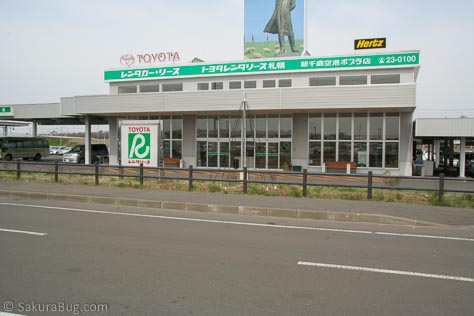
At this point, you must be wondering if you need to understand or speak Japanese to book the rental car. Toyota Rent a Car does have English service available. There is an English version of the website plus booking hotline with an English speaking agent.
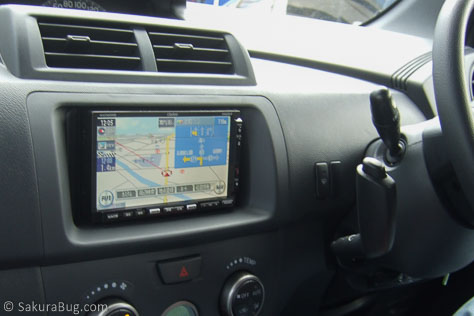
You can opt to rent cars that are equipped with GPS units that support English voice navigation. Do note that the GPS system is in Japanese, only the voice guidance system (left turn in 300m) has an English option. You are probably thinking, “Yikes! How is this going to work? I can’t even speak the language, how do I enter that Japanese address into the GPS?”
Not to worry. Typically, you would be expecting to enter your destination address into the GPS. This is how most vehicular GPS systems work. However, in Japan, you would not need to enter any addresses here. Instead, you would be keying in the destination telephone numbers. Simple enough right? After this experience, I was like why can’t this be done in other countries?
Furthermore, for popular destinations, there would be mapcodes available. This is generally a 10 digit number that you can key into the GPS under mapcode. Look for this logo: 
If you are keen to know more about the structure of the mapcode, you can check out this Denso site. Here are some examples of some destinations and mapcodes:
| Name of Place | Mapcode |
| Salmon Park Chitose | 113 889 556 |
| Biei | 389 011 664 |
| Shiretoko Pass parking | 757 492 298 |
At the rental car station, do get the staff to help set the basics. The first is to check that English voice navigation is enabled. The second is to set the GPS routing methodology. There are typically 3 options available – use “non-toll roads”, “shortest distance”, “most use of expressways”. I would generally suggest that you choose “most use of expressways”.
During my very first self drive trip in Hokkaido many years back, the option was set to “non-toll roads”. I was scratching my head, wondering why I seemed to be driving through narrow winding roads instead of wide straight open expressways.
Travelling distances can be long. Fortunately, the expressway network does cover a large part of Japan and you will be able to use the expressways most of the time. For more detailed info on the expressway network, you can check out these websites:
- Eastern Japan including Hokkaido (East Nippon Expressway Company Limited)
- Central Japan (Central Nippon Expressway Company Limited)
- Western Japan (West Nippon Expressway Company Limited)
The GPS models are also smart enough to switch to expressway mode navigation, showing you the next few exits and the distances. So driving on the expressway is a breeze. However, you will need to pay for using the expressways though. You can choose to pay manually or use the ETC (Electronic Toll Collection) card. There are separate lanes at the toll booth.
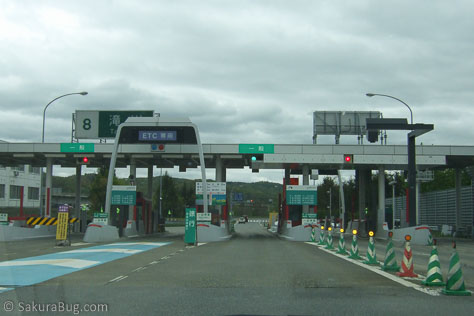
The ETC transponder is generally attached to the front windscreen behind the rear view mirror. However, the card unit is usually tucked away in the glove compartment. For manual payment, you will pick up an entry ticket just before going into the expressway and then submitting this ticket for payment at exit. There is a more detailed description at the E-NEXCO Drive Plaza site.
The next thing to pay attention to is the type of car that you will be renting. Other than considering seating capacity, you need to be consider storage capacity too. Rather than rent the typical sedan car, I would strongly suggest that you rent a station wagon instead. If you are like me, travelling with kids, you would have quite a few big luggage bags with you, maybe a pram as well. There’s where the rear cargo space of station wagon shines and from what I have seen so far, for the same price as the equivalent sedan model.

Do note that child seats are mandatory in Japan. You will be able to rent them as well. There are 3 different types available, based on your child’s age/size. You can find this in the options section.
Now getting to traffic rules and regulations. With the exception of a few countries, where your driver’s licence will suffice, you need to produce an International Driving Permit (IDP) to rent a car. This document needs to be issued in your home country and is required for every driver that will be driving the rental car.
The road system is based on the right hand drive system. The driver’s seat is on the right side of the vehicle. Vehicles drive on the road keeping to the left side of the road. Majority of Japanese cars have the light and turn signal levers on the right side of the steering wheel, and the wiper lever on the left.
Maximum speed limits for vehicles are shown on traffic signs and road markings. They are indicated in km/h. If there are no speed limit signs present, speed limits of 60 km/h on ordinary roads, and 100 km/h on expressways apply for ordinary cars.
Most of the road signs are graphical. You can see a sample of these at the Toyota Rent a Car website. You can also visit the JAF (Japan Automobile Federation) site for more info.
You might want to take note of these 2 regulatory signs with Japanese words on them:


Generally, unless you are in the main city areas, driving is quite a breeze. Japanese drivers are quite patient so it should be quite a relaxing drive.
Are you ready to book your rental car for that free and easy trip?
Ja
KL