
Thinking of a free and easy trip to Japan? Try a self drive trip in Hokkaido (北海道). Here are 3 reasons why Hokkaido is a great destination.
1. Easy for self drive
Of the four main islands that form Japan, Hokkaido is the second largest. However, it is the least developed. It accounts for around 20% of Japan’s land mass but only around 5% of the population. This low population density creates a generally relaxed environment far from the madding crowd.
Hokkaido houses an international airport in Chitose. There are a few international airlines that fly direct into the New Chitose Airport. If not, there are many regular, almost hourly flights connecting from Narita, Haneda or Osaka. It is very convenient to fly into Hokkaido. If you want to be closer to your destination, there are other domestic airports within Hokkaido for more direct access.
The rental car stations are located either beside or offsite but near to the airport. In which case, there usually would be shuttle buses operated by the rental car company to bring you to the offsite location.
From a road network perspective, the expressways do cover a large part of Hokkaido. The expressway operator for Hokkaido is the East Nippon Expressway Company Limited, or sometimes abbreviated to East NEXCO. You can find more info on the expressway network here.
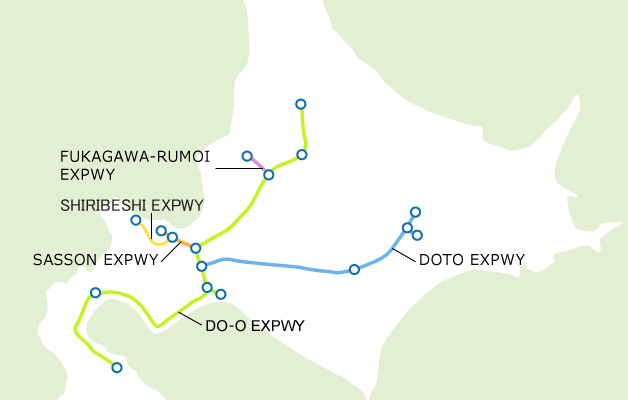
As you can see from the map provided by East NEXCO above, the expressways do cover a big part of Hokkaido especially on the central and southern areas. You will be able to use the expressways most of the time if you are in both these areas.
So self drive is a breeze in Hokkaido.
- Hokkaido is easily accessible as a destination
- Road traffic is generally low as the population density is low.
- Good expressway network covering a good part of Hokkaido
- Rental cars are easily available.
2. Great place for flowers and autumn colours
My fascination in Hokkaido started with wanting to partake in the Sakura season. Other than Sakura or Cherry Blossom, there are many other beautiful flowers and magnificent sights to catch at different times of the year.

The climate in Japan could vary significantly as you look across the southern to the northern end of Japan. Hokkaido is located on the northern-most end of the four main islands of Japan. It tends to have a shorter summer and longer winter. This also impacts the timing of when the different flowers bloom in Hokkaido.
Some of the other flowers that you could view are the Wisteria, Tulip, Lavender, Moss Pink, Sunflower and Lilac. Here is a table of some of the approximate timing when they are in bloom.

For recommended places to view the Cherry Blossoms, please see my previous articles on Sakura viewing in Central Hokkaido and Southern Hokkaido. For the other flowers, if I hear enough feedback, I will write a full article on them. Reason for another Hokkaido adventure :).
In the meantime, here are some possible places to go to amongst others.

Of course, the main flower belt is in Central Hokkaido, in the Biei/Furano area. So if you do not want to travel too much, then you might want to stick around Biei/Furano. However, you will need to travel around Hokkaido if you want to view a greater variety of flowers.
3. Choice of 6 national parks including UNESCO site Shiretoko
With 20% of the total land mass and 5% of the population, you get to enjoy a lot of pristine mostly unspoiled nature areas. There are 6 National Parks in Hokkaido for you to choose from:
- Daisetsuzan National Park
- Shikotsu-Toya National Park
- Akan National Park
- Shiretoko National Park (UNESCO site)
- Kushiro-shitsugen National Park
- Rishiri-Rebun-Sarobetsu National Park
Daisetsuzan is the largest national park in Hokkaido and in Japan. It covers an area of around 226,000 ha in Central Hokkaido. Mt. Asahidake, which is Hokkaido’s highest peak, is part of the national park and stands at 2,291 m above sea level. In this huge expanse of land with different climatic conditions due to the varying elevations, you can find a rich diversity of wildlife such as brown bears, sika deer, red fox, Japanese Pika and Hokkaido squirrels. If you are into bird watching, you might be able to catch a glimpse of the Blakiston’s fish owls or the rare Eurasian three-toed woodpecker on a lucky day.
Shikotsu-Toya National Park, which is almost half the size of Daisetsuzan (around 96,000 ha), is also in the Central Hokkaido region located near to Sapporo. This is an area known for its volcanic activity and hot springs. Noboribetsu is one of the well known areas for its hot springs here.
For Akan National Park and Kushiro-shitsugen National Park, please check out my earlier post on interesting places to visit while in Kushiro. For Shiretoko National Park, which is a UNESCO site, do read my earlier post on a self drive trip to Shiretoko.
Rishiri-Rebun-Sarobetsu National Park is the smallest of the 6 national parks here, at around 24,000 ha, located in Northern Hokkaido. The key attractions here are Mt. Rishiri, Rebun-to Island, the Coastal Sand-dune Area and the Sarobetsu Plain. Unfortunately, I have yet to make a trip to the northern extreme of Hokkaido, something that I would like to do in the future.
What you waiting for? You have your 3 reasons, time to make that Hokkaido self drive trip!
Ja
KL


 894 727 045) is one of the popular attractions where you will find many tourists. Access is from the main road which leads into a parking area. It is quite easy to locate as the waterfall can be seen from the main road. From the car park, there an access path with guide rails for you to climb up the trail for a better view of the waterfall.


