Tag Archives: Hokkaido

Best Sakura viewing places in Central Hokkaido

As we are still in Sakura season, I have decided to continue with another edition of “Best Sakura viewing places in Hokkaido”. Previously, I had covered Cherry Blossom viewing in Southern Hokkaido via a free and easy trip.

This time round, I will be covering Sakura or Cherry Blossom viewing in Central Hokkaido. There are 3 great places for you to consider, or you could visit all three in a self drive trip.

1. Murayama Park

The first place would be Maruyama Park, which would be the easiest to get to of the 3 places covered here. Maruyama Park is located in the western part of Sapporo under Maruyama mountain. Here, you will find more than 1,500 Sakura trees in the park. There are also giant elm and cypress trees located within the park grounds.

Maruyama Zoo and Maruyama Baseball Stadium are also in the same vicinity. There is roadside parking around the Zoo or paid parking lots beside the Stadium if you are entering the park from the west end. If you are taking the train, you wold be entering from the east end which is closest to the train station.

I had based my self drive itinerary out of Chitose and drove up north to Sapporo for my day trip using Maruyama Zoo as the target destination in the GPS. However, there was quite a crowd going to the zoo that day, taking up all available roadside parking. I had to park at the stadium instead. As this is a fairly large park, you would probably want to allocate at least half a day so you could take a leisurely stroll, exploring the sights in the area.

My timing was not perfect but I managed to catch the tail end of the Sakura season. The falling Sakura flower petals floating in the air were such a wonderful sight to behold.
Picture of falling Sakura flowers floating in the wind
Falling Sakura flowers floating in the wind

Other than Sakura viewing, you might want to visit the virgin forest to take in the magnificent view of the giant elm and cypress trees. If you are lucky, you might just catch a glimpse of the woodpecker at work.

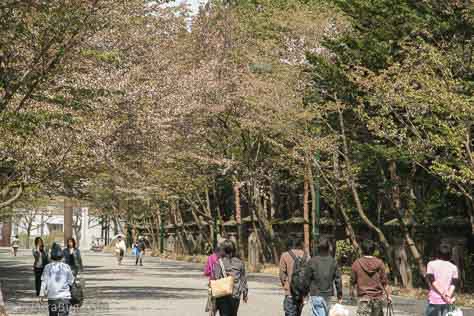
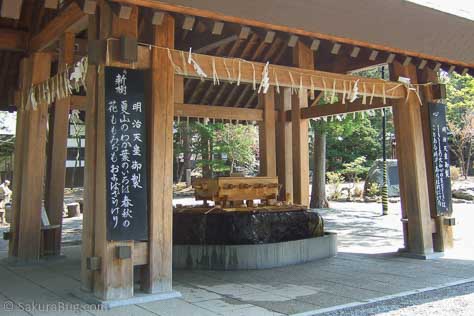
Following that, you could visit the shrines in the area, the famous one being Hokkaido Shrine. The path to the Shrine is lined with many Cherry trees making for a very scenic view during full bloom. The Hokkaido Shrine was built in 1869, with an area of around 180,000 square meters. The local people visit the shrine on celebratory occasions such as weddings or to receive blessings when they or their children reach certain ages. “Clean” yourself with the purification water at the entrance before making your way in. You can partake in the temple activities here or take a break in the rest area and sip the hot tea provided.
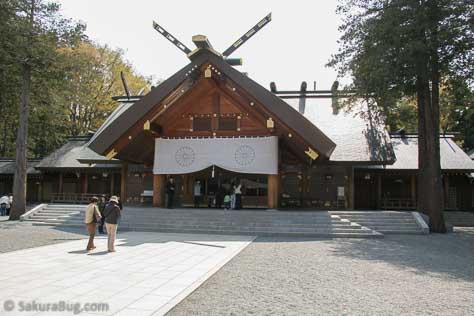
Picture of Hokkaido Shrine in Murayama Park
Hokkaido Shrine in Murayama Park
Picture of purification fountain beside Hokkaido Shrine in Murayama Park
Purification fountain beside Hokkaido Shrine in Murayama Park

If you have some time left, you could drop by the Maruyama Zoo (札幌市円山動物園). Maruyama Zoo is the first zoo in Hokkaido. It was built in 1951. The interesting feature is that they encourage interaction with the animals. There are a few exhibit areas established to support this interaction such as the “Tropical Animal House”, “Kangaroo House” and “Kid’s Zoo”.


2. Shizunai Nijukken (20-Ken) Road

The second place would be Shizunai Nijukken Road (静内二十間道路,  551 264 175), which is south of Sapporo, located in the Shinhidaka (新ひだか) town area. This is one of the places where you would appreciate being able to reach more inaccessible destinations with a self drive trip

There is some historical background to this place. “Ken” is an olden unit of measure.  This was a historical route and Sakura trees were planted 20 ken apart on both sides of the road to mark the path. Hence the name of the place. You can find more details of the background at this Japanese site. Today, there are around 3,000 Sakura trees over a 7km stretch of this road.

Although I had the mapcode of this destination, I was a little unsure since your typical destination would usually be some sort of building. Not this place, just roads, farmland, horses and open fields in your view. So I was not really sure that I had reached my destination, an open road. But then the sight of cars parked along both sides of the road and the picturesque view of the Sakura flowers was a better confirmation than the “You have arrived at your destination.” message.
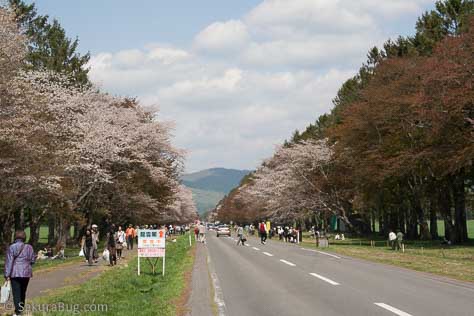
Picture of Shizunai Nijukken (20-Ken) Road
Sakura along Shizunai Nijukken (20-Ken) Road

Shinhidaka is also known as horse country. The many ranches that you see around are horse ranches. It is said that as much as 80% of the horses in Japan can be found here. Please do let me know if you can find more information on this. Most of the horses are bred for racing with the Japan Race House Association conveniently located here too.

Coincidentally, the Sakura season is also foaling time for the horses. As you are enjoying the view of the Sakura bloom, you can also catch a view of these new born foals with their parents.


3. Seidai Dam Park

Next we head north, towards Biei (美瑛) which is north of Sapporo. The third location that we are exploring is Seidai Dam Park (聖台ダム,  389 108 322). The Seidai dam was completed in 1937, as a source for irrigating the rice fields in the region.

Again, this is one of those remote spots where you will need a rental car to get around. This is not a well known area, not the touristy kind of place. However, this is a place where you can enjoy beautiful cherry blossoms in spring, lavenders in early summer and the autumn colours.

This could be a stop over point as you are making your way north towards Biei or Furano. Do come prepared though, bring a picnic basket along as there aren’t really any food establishments here.

Seidai Dam Sakura trees (picture from Town of Biei Tourism Association)

And yes, this is a great place to grab nice scenic shots. Be sure to grab this postcard shot before you leave.
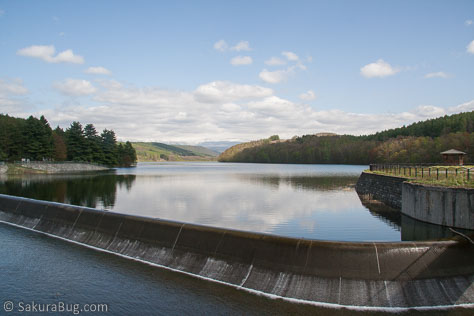
Picture of Seidai Dam
Seidai Dam post card shot


Ja
KL

Quick guide on driving in Hokkaido

Welcome! If you are planning a self drive trip to Hokkaido, this article is for you!

In an earlier post, I had mentioned that the road system in Japan is right hand drive – driver’s seat is on the right and vehicles keep to the left. And for most countries, you would need to have an IDP (International Driving Permit) to rent a car. You will need to complete this locally in your own country before departing for your free and easy trip.

I had also covered renting a car with Toyota Rent a Car in that post. Today we are going to focus on driving to your destination.

Here are some very useful Hokkaido maps that you can use to start planning your itinerary. I also love the one provided by Toyota Rent a Car. However, I have been unable to locate a PDF copy.

  1. Hokkaido Tourism Organization: Drive Hokkaido (front, back)
  2. Hokkaido Tourism Organization: Travel Around Hokkaido
  3. Ministry of Land,Infrastructure, Transport and Tourism Hokkaido Regional Development Bureau: Must-have Handbook for Driving in Hokkaido

Hokkaido is large territory that you would not be able to cover all of Hokkaido within in single trip. Now if you planning to be there for a month, it would be a different story. For your typical one week itinerary, I think you would be need at least 4 self drive trips, roughly covering Southern Hokkaido, Central Hokkaido, Northern Hokkaido and Eastern Hokkaido. If this is your first driving trip, I would suggest that you start with either Central Hokkaido or Southern Hokkaido.

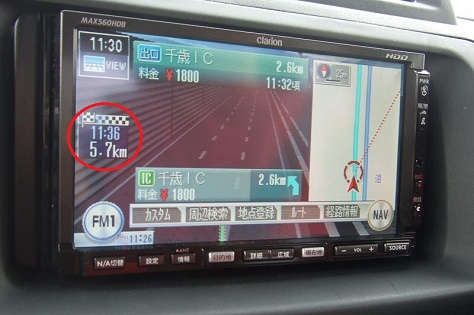
Some of the maps mentioned above do provide a grid of estimated travel times between cities. This would be very useful for your trip planning purposes. Most of the distances are quite far away, do not under estimate the travel time required. Outside the city areas, there are no street lights on the highways nor expressways. So do plan to arrive at your destination before sunset. Do also plan for rest stops and meal breaks. When you are finally on the ground, your trusty on-board GPS will compute an estimated arrival time at the destination.

Picture of GPS showing estimated arrival time and distance left
GPS showing estimated arrival time and distance left

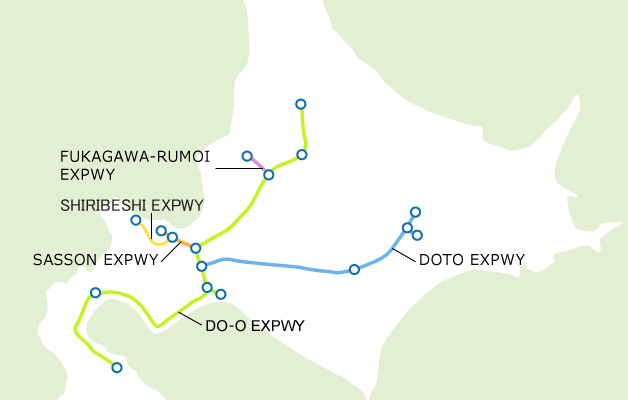
Fortunately, the expressways do cover a large part of Hokkaido. The expressway operator for Hokkaido is the East Nippon Expressway Company Limited, or sometimes abbreviated to East NEXCO. You can find more info on the expressway network here.


Picture of Hokkaido Expressway network (from NEXCO)
Hokkaido Expressway network (from NEXCO)

As you can see from the map provided by East NEXCO above, the expressways do cover a big part of Hokkaido especially on the central and southern areas. You will be able to use the expressways most of the time if you are in both these areas. However, you will need to depend on the normal highways for Eastern Hokkaido and also the northern end of Hokkaido.

The GPS system is also smart enough to know when you are on the expressway and it switches to expressway mode navigation. In this mode, the GPS will display the next few exits and the distances to these exits. If the exit includes a rest stop, it will also give you an indication of the facilities there, for example if there is a station at that rest stop.

So driving on the expressway is a breeze. However, you will need to pay for using the expressways though. You can choose to pay manually or use the ETC card. Credit cards are generally accepted. However, there are some stretches where it’s just a fixed amount of toll collected at entry.

For foreigners, there is the option of the Hokkaido Expressway Pass which gives you unlimited expressway travel for a fixed fee. You can find out more about using the ETC card and the Hokkaido Expressway Pass here.

If you are planning on covering a large part of Hokkaido with frequently use of the expressways, the Hokkaido Expressway Pass would probably be a good option to consider.

Here are 5 other things to take note of when using the expressways.

1. Number of lanes

The word expressway would probably conjure an image of a wide road with multiple lanes and fast free flowing traffic. That assumption is not correct. On some stretches, the expressway could be just one lane wide. For example, the Doto expressway, which brings you towards the east side of Hokkaido is a single lane expressway. Fortunately, there are over-taking lanes spaced out along the expressway.

2. Merging traffic

In different parts of the world, different traffic rules and etiquette prevail and it is important to follow the local norms. If you have merging traffic coming in from the left, typically entering into the expressway, you should slow down and give way to the incoming traffic.

3. Variable speed limit

The speed limit on the expressway is variable. It depends on road and weather conditions. LED signposts indicate the speed limit along that stretch of road. If there signposts are off or if there are no signboards, the maximum speed limit along the expressway is 100 km/h.

4. Cross winds

If you slow down to appreciate the construction of the expressways, you will find it an engineering marvel. It cuts through the mountainous valleys providing an elevated pathway for motor vehicles. It is also likely along these elevated sections that you would encounter strong cross winds. Do keep an eye out for signs indicating that you are in a windy area and keep both hands on the steering wheel.

5. Driving fatigue

Driving distance can be long and monotonous on some stretches. You do want to be alert driving at high speed along the expressway. So do make a rest stop every couple of hours, stretch yourself and get a cup of coffee. What you probably want to look for are SAs (Service Area), which usually have snack corners, food court dining area, gift shop, petrol station, parking spaces and toilets. You can check out E-NEXCO’s Drive Plaza site for info on these SAs.

These SAs are also known as Michi-no-Eki (道の駅). You can locate more info at the All Nippon Michi-no-Eki Network. Some of these SAs can be very popular or elaborate. Popular as it may offer something unique like local produce. Elaborate as some could contain a shopping center, restaurants, lodging or even a pet run area. Touring some of these SAs can be a discovery adventure in itself.

That’s all for today, are you ready for some driving in Hokkaido?

Ja
KL

5 reasons to use Chitose as Hokkaido trip base

Are you planning for a Free and Easy trip to Hokkaido? Here are 5 reasons why you should make Chitose as your base.

(1) Main Hokkaido airport is in Chitose
Most of us would think of Sapporo when travelling to Hokkaido. However, like most cities, the airport is usually located some distance off. The main airport is in Chitose, located south of Sapporo. As the main airport and an international airport, it offers the most connections into Hokkaido.

Although Chitose is an international airport, there are limited international flights that would fly direct into Chitose. In most cases, you would probably be transiting through Tokyo/Narita (NRT), Tokyo/Haneda (HND) or Osaka/Kansai (KIX).

My personal preference is Kansai since none of my preferred airlines fly direct to Chitose. Why Kansai you might ask? There are limited flights from Narita to Chitose. And while Haneda now does support international flights, there are limited international flights into Haneda. Kansai is an international airport and there are regular flights to Chitose. Which means I can land in Kansai, walk over to the domestic terminal to get my connecting flight to Chitose. You could of course take the train or other transport to get from Narita to Haneda, but with kids in tow, it wasn’t a good option for me.


(2) Collect rental car, local brochures and maps leisurely
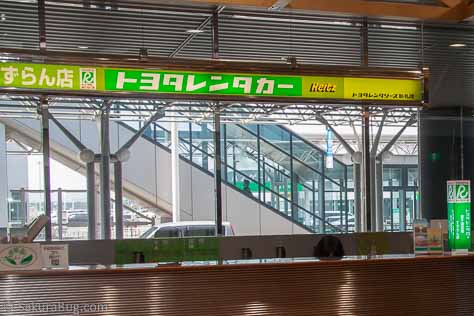
After clearing immigration and customs, you would want to pick up your rental car. Make your way to the car rental counters at the airport and bring your bags with you as the car rental centres are located off the main airport terminal. Each of the car rental companies will have their own shuttle buses to bring you to their rental centres. (More info from Toyota Rent a Car here.)

Picture of Toyota Rent a Car counter at Chitose airport
Toyota Rent a Car counter at Chitose airport


For info on renting from Toyota Rent a Car, please see my earlier post on Helpful tips for self drive and car rental in Japan.

The Toyota Rent a Car rental centre is full of brochures. Take your time to browse around and collect maps and travel brochures from the shelves. Toyota Rent a Car provides an excellent booklet which has a big map of Hokkaido, and smaller maps of key cities in Hokkaido. You should also be able to pick up hardcopy versions of the maps that I have mentioned in my next post on Quick guide on driving in Hokkaido (Part 1).


(3) Visit the supermart to stock up on supplies
No need to pack your bursting bags with too much supplies from home. You can get snacks, fruits, biscuits, sweets, drinks, water, instant noodles, soap and detergent for the trip locally.

Your first stop would be to the supermarket (like Aeon) to get supplies. The Chitose Aeon store is near to the JR Chitose Station.

Picture of Aeon stores in Hokkaido
Aeon stores in Hokkaido, Chitose store, 千歳店, phone: 0123-24-3100 (Image from Aeon website)


It would be cheaper than getting some of these at the convenience stores later. Do ask for some cardboard boxes to pack these so you can load them up easier into the car.

For those with young kids, you can get diapers here too. And if they need porridge, there are ready to eat porridge packs which you can warm up with hot water.


(4) Short stress free drives to get familiar with the GPS
After the supermarket trip, it’s time to head for dinner. The trip to the supermart was your first short drive within Chitose. No stress as this is a small town and the traffic is light; so you can drive around rather leisurely. You need to get a better feel of the GPS voice guidance system to figure out exactly what distance it means when you get a prompt like turn right in 300m and turn left in 30m.

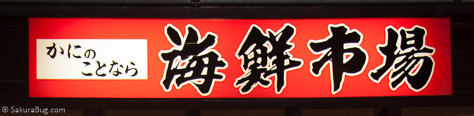
So take another short drive to a dining spot. My favourite is this small cozy Japanese restaurant, 海鮮市場 (Kaisen-Ichiba, 0123-23-7373, 4.30pm~11pm).

Picture of Restaurant Kaisen Ichiban in Chitose, Hokkaido
Restaurant Kaisen Ichiban in Chitose, Hokkaido


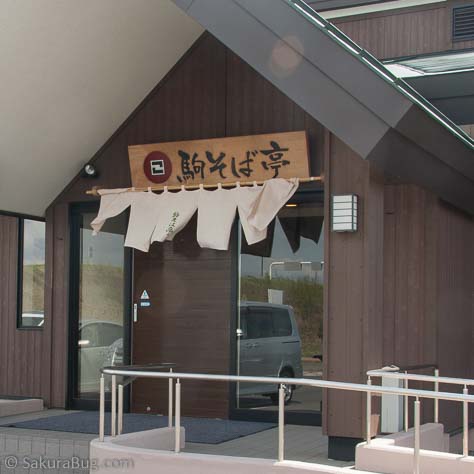
Or, you could try out this Soba restaurant, 駒そば亭 (0123-40-8816, 11am~8pm), which is near to the Rera Outlet Mall.

Picture of Soba restaurant in Chitose, Hokkaido
Soba restaurant in Chitose, Hokkaido


(5) Cheap lodging for the night
Following dinner, you would want to get to your hotel room and wind down. Unless you were on a red eye international flight, it would be quite late by the time you got into Chitose. There are quite a few business hotels within Chitose. These offer low cost accommodation and free parking for the night.

Picture of Chitose Airport Hotel

Chitose Airport Hotel (Image from Chitose Airport Hotel website)


I have stayed at Chitose Airport Hotel, Wing Hotel and Hotel Kameya. Chitose Airport Hotel is walking distance to the JR Chitose Station. Wing Hotel has newer furnishings but is further away from the JR Chitose Station.

Now would be a good time to look at the maps and brochures that you had collect at the rental car centre and confirm what you want to do for the next day or next few days. Some of these brochures also come with tourist discount coupons for the attractions.

Usually I do not have a complete itinerary for the trip. I would just have a rough driving route in mind and some key places to visit. There’s fun in discovering new things along the way and not having too rigid an itinerary.

Now, it does not mean that I am not prepared at all. I would reserve the rental car and book the first night or first two night’s accommodation and take care of the rest along the way. I will also look at some possible accommodation options for other nights. So as I confirm the itinerary for the next day or next 2 days as I progress, I can decide which accommodation option would be better. And along the way, if the accommodation options are along the route, I will check them out.

Once your itinerary for the next day is done, time to get some rest. Hokkaido is big enough that you will be driving long distances. So get well rested for the drive the next day.

Sleep tight!

Ja
KL