One of the activities that I had always been looking forward to is to go fruit picking at a fruit farm. However, I never seem to be able to get this into the itinerary. So, when I was in Aomori for a free and easy trip, I put in both the visit to the Hirosaki Apple Park and to Morino Nakano Kajuen (森の中の果樹園, 080-1821-3059).
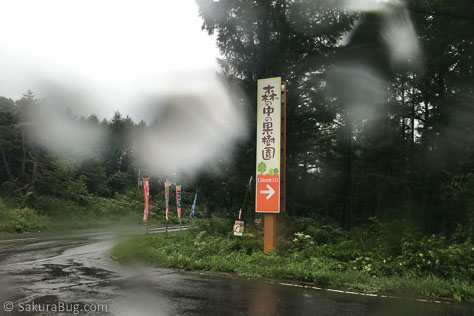
Morino Nakano Fruit Farm is located within Hirosaki in the Aomori prefecture. It is quite a short drive north, around 30 minutes, from the Hirosaki city area. You would be driving along Route 30 heading north, in the general direction of Mt. Iwaki. From Route 30, you will be making a right turn into a side road leading to the fruit farm. There are signboards near to and at the right turn.
Signboard to Morino Nakano Fruit Farm along Route 30Signboard to Morino Nakano Fruit Farm along side road off Route 30
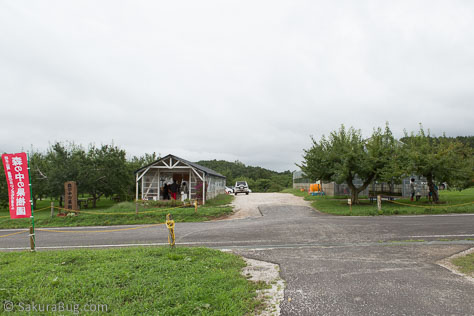
It was a cloudy morning with some drizzle as I drove to the fruit farm. It took me a while to find the find the farm as I was looking for a farm building and a demarcated parking area. The “building” was more of a shed with a small signboard in front. You can park your car around the grass patch just behind the shed. Yes, free parking.
Entrance of Morino Nakano Fruit FarmMap of Morino Nakano Fruit Farm
Once you have parked, you can make your way to the shed. This is where you will buy your ticket, which costs 1,200 (yen) during the off-peak season and 1,500 (yen) during the peak season for an adult ticket. You will be issued with a basket and a pair of scissors. You can also get a pair of boots plus an umbrella here if you need them. This ticket allows you to pick as much fruit as you can eat on the spot plus a small quantity to take away.
As you were passed the basket and scissors, you would have been briefed to only pick fruits from the trees with a pink ribbon. And off you go to the fruit orchards to pick the fruits.
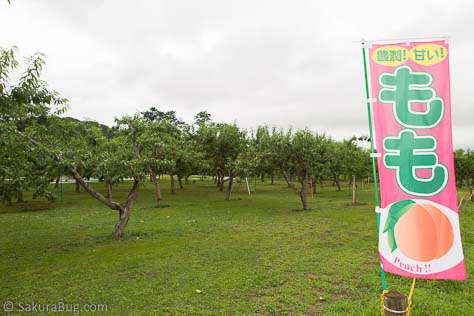
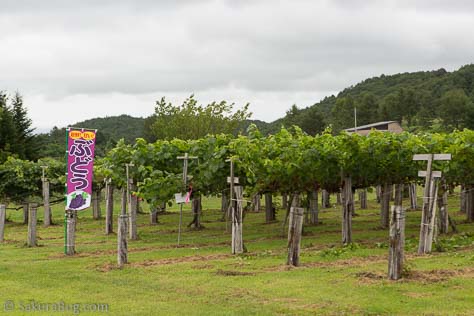
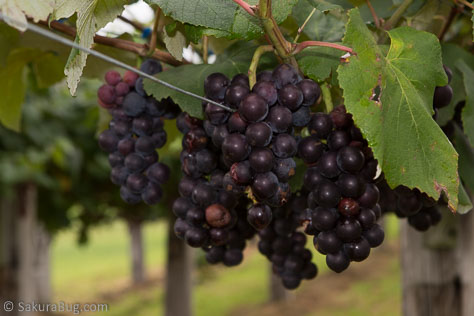
Peach plantation at Morino Nakano Fruit FarmPeach tree at Morino Nakano Fruit FarmGrape plantation at Morino Nakano Fruit FarmGrapes at Morino Nakano Fruit Farm
I had a great time roaming through the different fruit orchards. I had my pick of different varieties of peaches, grapes, prunes and plumes, Pity there weren’t any strawberries. I guess I need to visit again during a different season.
During a recent free and easy trip to Japan, I had an opportunity to spend a couple of days in Hirosaki (弘前市), a regional centre with a population of around 180,000, located in the Aomori prefecture, the largest apple producing prefecture in Japan.
Picture of apple in Hirosaki Apple Park
Aomori has more than 21,000 hectares of farming land for apple cultivation. The prefecture produces more than 50% of the apples in Japan, the main varieties being “Fuji”, “Tsugara” and “Jonagold”.
One would wonder why is Aomori so famous for its apples. There are various reasons for this. Firstly, the cool climate and the temperature differences are perfect for growing apples. The apples get the sun in the day, and store sugar in the night, and this repeating cycle produces the sweet characteristic of Aomori’s apples.
Secondly, the farmers are experienced, hard-working and employ specialized cultivation technics. Apple farming is a very manual and labour intensive process. The farmers here are dedicated and spend huge amounts of time maintaining the apple trees, for example, pruning the trees to ensure that sunlight can reach the apples. The farmers start the trimming process as early as January, during the winter season, to tune each tree for optimal sunlight.
Third, from an infrastructure perspective, there are specialized storage warehouses for the apple farming community. These facilities allow farmers to keep the apples under optimal conditions as they ripen and get shipped out for consumption.
But most importantly, the farmers are very passionate about their apples. Hence we get sweeter, bigger, juicy, crispy and delicious looking apples from Aomori.
Hirosaki Apple Park
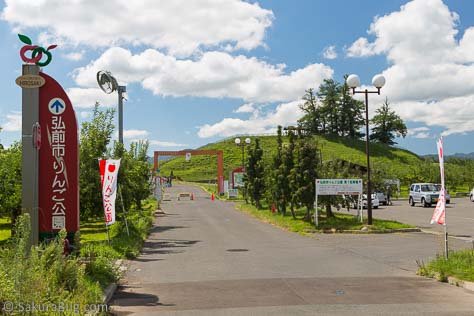
There are quite many apple farms within Aomori. If you are in the Hirosaki area, the Hirosaki Apple Park (弘前市りんご公園, Tel: 0172-36-7439) is a great place to visit and it’s quite convenient to get to. If you are in the Hirosaki city area, it’s a short 15min drive to the park. Entry to the park is free. If you are on a self drive trip, free parking is also available at the entrance to the park.
Entrance to Hirosaki Apple Park
The road leading to the park are small narrow streets, so you do need to keep a lookout for the signboard and turn into the small side street. I missed it the first time and had to drive through a second time.
Map of Hirosaki Apple Park
The Hirosaki Apple Park has a production area of around 2.49 hectares, housing 1,500 apple trees from 80 varieties. At the park, other than apple picking, you can also participate in the apple production experience. The apple production experience can start around May and the actual activities will depend on the production cycle at that time of the year. For apple picking, you will need to be there during the harvest season, which is around Aug to mid-Nov.
In addition, these are some of the festivals that are held at the park. Please do check before you travel as the festivals and timing do change from year to year.
Hirosaki apple harvest festival (Sep)
Hirosaki apple flower festival (May)
Hirosaki apple park winter festival (Jan)
Infoboard at Hirosaki Apple Park
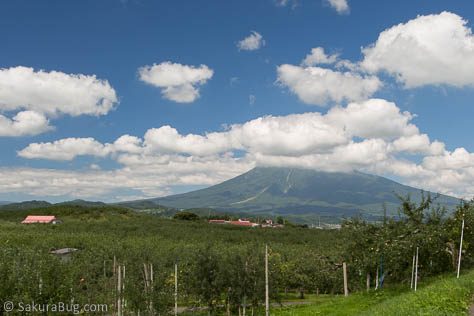
You can take a leisure stroll around the park to look at the different apple trees and enjoy the scenic view with Mt. Iwaki in the background.
View at Hirosaki Apple Park overlooking Mt. Iwaki
Alternatively, you could rent a bike from the Apple House near the entrance. Or explore the variety of 1,250 apple products within. If you are hungry, there’s a small café as well. Yes, apple ice cream is available at the Apple House!
For those travelling with kids. There are 2 fairly large playground/ picnic areas within the park. You can take a break there while the children have fun with the slides. Do bring along a mat and picnic basket with you for the trip!
Today, I would like to share with you my self drive trip to the Shirakami Sanchi (白神山地), one of the four UNESCO World Natural Heritage Sites in Japan. If you are wondering which are the four sites, here’s the list:
Shirakami Sanchi sits across the border of Aomori and Akita, an extensive mountain range known for its natural Japanese beech (or buna) forests with a size close to 17,000 ha. It was added as an UNESCO World Natural Heritage Site in 1993.
When you are visiting Shirakami Sanchi, you are probably visitng the surrounding area as the core conservation area is quite inaccessible and requires a permit for entry. However, even the surrounding area holds many nature wonders for the visitor.
The best times to visit are late spring/early summer season where the waterways would be full from the melting snow and rain and autumn season to catch the changing foliage. Do note that many of the access roads are closed from November through May.
As the site is rather vast, you will need to do some planning for your trip. Which places to visit together, how much time would be need at each of the places of interest and travel time between places. Here are some of the places to visit, most of which would a rental car to move around.
1. Shirakami Sanchi Visitor Centre
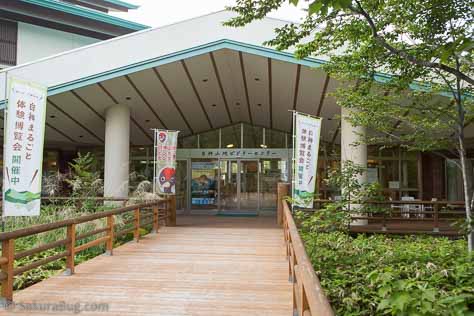
The Shirakami Sanchi Visitor Centre (白神山地ビジターセンター, 0172-85-2810) is located in Aomori prefecture, on the east side of the national park along route 28, easily accessible if you are coming from Hirosaki, roughly 30 to 45 minutes by car.
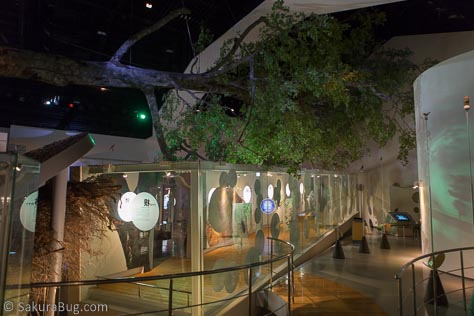
Entrance of Shirakami Sanchi Visitor CentreInterior of Shirakami Sanchi Visitor Centre
There are 3D models of the fauna and ecosystem inside, with extensive coverage of the beech eco system. In addition, an IMAX screen shows a 30 minute film about the area a few times daily. The opening hours of the visitor centre are seasonal, with it being closed on some days, usually Monday, so do check before making a trip down.
2. Aqua Green Village Anmon and Anmon Falls
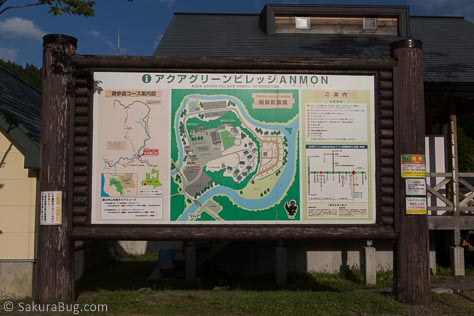
The Aqua Green Village Anmon < http://www.kumagera.net> (アクアグリーンビレッジANMON, Tel: 0172-85-3021) is also located on the eastern side of the National Park. Here, you can find lodging, an onsen, a campground, specialty store and a huge play area. A place which you could use as a base for touring the eastern side of the Shirakami Sanchi World Natural Heritage Site.
Map of Aqua Green Village Anmon
From the Village, there are various walking trails available. One of which is the Beech forest walking trail, a 2km route (round trip) taking about 60 to 120 minutes.
The hiking trail to the Anmon Falls is also accessible from the village. The Anmon Falls are a set of three waterfalls. It will take around 45 to 60 minutes to reach the first fall and another 30 to 45 minutes to reach the other two.
3. Mount Futatsumori
On the western side of the park, which is more easily accessible from Akita, you have Mount Futatsumori from which you can get a great view of the mountains and valleys at the peak standing at an elevation of 1,086 m. The climb starting from the Futatsumori Mountain Trail Entrance, near to the car park, to the peak takes roughly 1 hour.
4. Juniko
Also on the western side of the park, further north along Route 101 but tranversing into Aomori prefecture, you will find Juniko (十二湖). Juniko literally means twelve lakes.
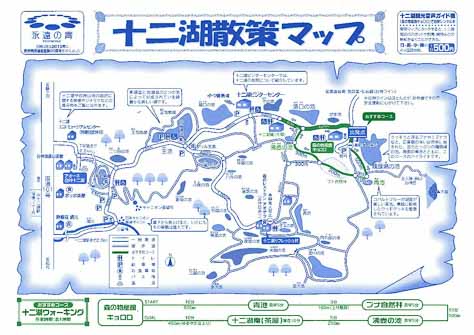
The GPS brought me to somewhere in Juniko, although I had keyed in the phone number for the Juniko Visitor Centre, leaving me to figure out my way around. Luckily, I managed to get hold of an area map.
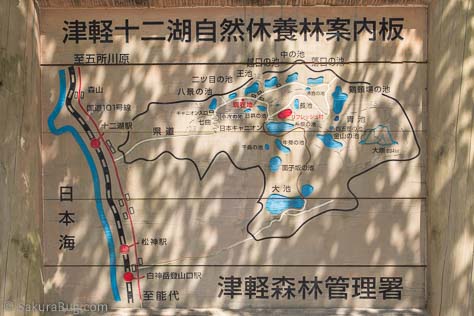
Juniko area map (click image for PDF)
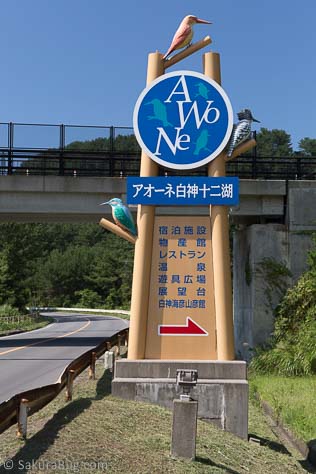
There are 2 entrances along Route 101 near the Juniko station into Juniko. If you are travelling north to Shirakami Sanchi from Akita, like what I did, I would suggest that you enter via the second entrance. The first entrace is just before the Juniko station, the second entrance is a little after the Juniko station. The second entrance will lead you into AWONE Shirakami Juniko <http://shirakami-jyuniko.jp/> (アオーネ白神十二湖, Tel: 0173-77-3311). You should see this signboard at the second entrance.
Entry signboard to AWONE Shirakami JunikoEntrance of AWONE Shirakami Juniko
There is lodging available here if you want to make this a base for your western foray into Shirakami Sanchi. There are souvenir shops, restaurants and an outdoor play area here too. I had my lunch here and made my plans using the area map while having lunch. The 12 lakes are quite scattered and involves driving through narrow roads to reach each of them.
Juniko signboard
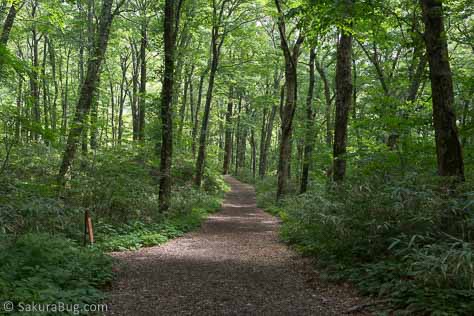
There is a recommended walking trail right at the end which takes you across 4 of the lakes as well as a beech forest – see the green marked trail in the area map. The estimated time needed is one hour. There is paid parking available at the start of the trail. Though I must say this is based on an honour system. Most people park their cars then make their way to the manual payment booth at the entrance of the car park.
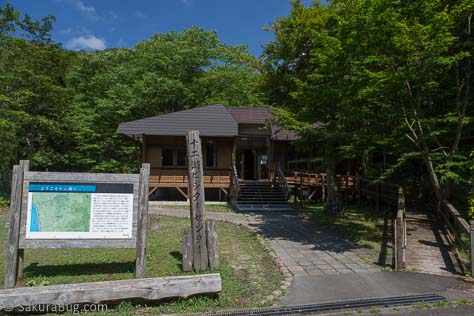
Juniko Visitor Centre
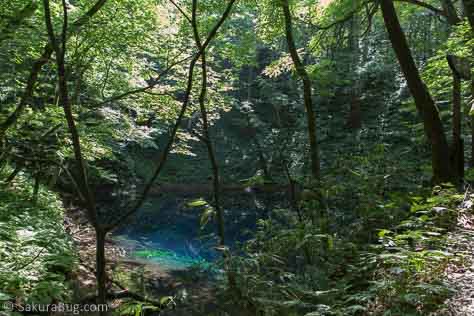
I located the Juniko Visitor Centre, which is an unmanned hut, had a quick look around before heading to the recommended walking trail. It is quite an easy walk, but do keep a watch out for vehicles on the small section towards the end, heading back to the start point, as you will be walking on the narrow road. Here’s a picture of the Aoike Pond along the trail and also the beech forest.
Aoike Pond in JunikoBeech forest in Juniko area
Yes, there is a souvenir shop with refreshments for sale at the entrance of the car park, your start and end point for the hike.
5. Route 28
No, do not try to cut through Route 28. After completing your explorations on the western end of Shirakami Sanchi, it is tempting to use Route 28 to reach the eastern end as it looks like a short cut. Here’s a local map snapped from an info board, do note that north is down, so Akita is on the right and Hirosaki is on the left.
Info board for Shirakami Sanchi
At the Shirakami Sanchi stretch, Route 28 has around 41km of unpaved winding road that you will need to drive through. Most of the stretches are wide enough for just one vehicle to pass through, and mind you, it’s a 2 way road. You would be driving mostly at speeds of around 20 to 30 km/h, taking close to 3 hours of slow and painful driving to get through. Throughout the entire journey, less than 10 vehicles had passed me from the other direction.
Unpaved road section along Shirakami Sanchi stretch of Route 28
I also like this map from Japan Guide showing the unpaved road sections. Unless you are planning to use the lookout points along Route 28, I would suggest that you use take Route 101 further north before looping down into Hirosaki and the eastern end of Shirakami Sanchi.