One of the activities that I had always been looking forward to is to go fruit picking at a fruit farm. However, I never seem to be able to get this into the itinerary. So, when I was in Aomori for a free and easy trip, I put in both the visit to the Hirosaki Apple Park and to Morino Nakano Kajuen (森の中の果樹園, 080-1821-3059).
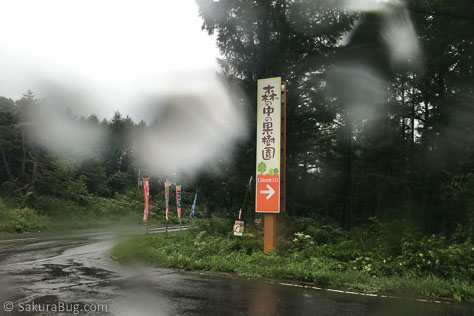
Morino Nakano Fruit Farm is located within Hirosaki in the Aomori prefecture. It is quite a short drive north, around 30 minutes, from the Hirosaki city area. You would be driving along Route 30 heading north, in the general direction of Mt. Iwaki. From Route 30, you will be making a right turn into a side road leading to the fruit farm. There are signboards near to and at the right turn.
Signboard to Morino Nakano Fruit Farm along Route 30Signboard to Morino Nakano Fruit Farm along side road off Route 30
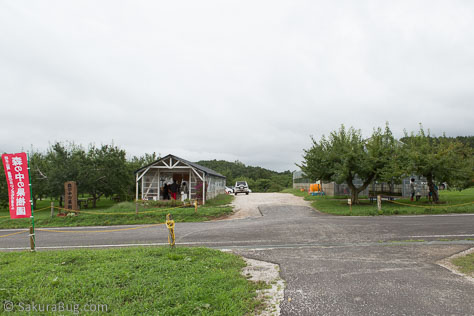
It was a cloudy morning with some drizzle as I drove to the fruit farm. It took me a while to find the find the farm as I was looking for a farm building and a demarcated parking area. The “building” was more of a shed with a small signboard in front. You can park your car around the grass patch just behind the shed. Yes, free parking.
Entrance of Morino Nakano Fruit FarmMap of Morino Nakano Fruit Farm
Once you have parked, you can make your way to the shed. This is where you will buy your ticket, which costs 1,200 (yen) during the off-peak season and 1,500 (yen) during the peak season for an adult ticket. You will be issued with a basket and a pair of scissors. You can also get a pair of boots plus an umbrella here if you need them. This ticket allows you to pick as much fruit as you can eat on the spot plus a small quantity to take away.
As you were passed the basket and scissors, you would have been briefed to only pick fruits from the trees with a pink ribbon. And off you go to the fruit orchards to pick the fruits.
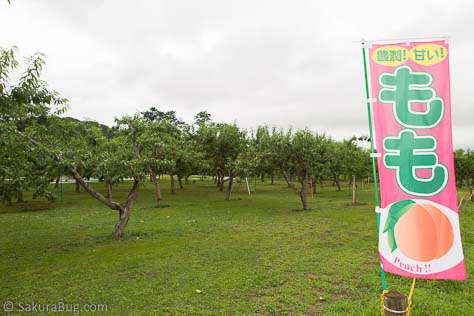
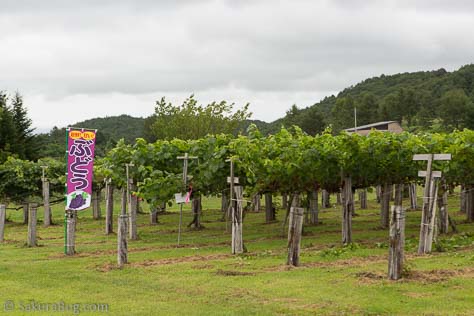
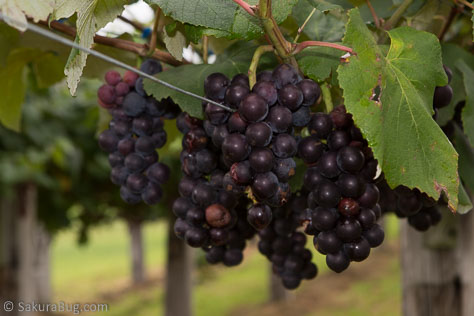
Peach plantation at Morino Nakano Fruit FarmPeach tree at Morino Nakano Fruit FarmGrape plantation at Morino Nakano Fruit FarmGrapes at Morino Nakano Fruit Farm
I had a great time roaming through the different fruit orchards. I had my pick of different varieties of peaches, grapes, prunes and plumes, Pity there weren’t any strawberries. I guess I need to visit again during a different season.
During a recent free and easy trip to Japan, I had an opportunity to spend a couple of days in Hirosaki (弘前市), a regional centre with a population of around 180,000, located in the Aomori prefecture, the largest apple producing prefecture in Japan.
Picture of apple in Hirosaki Apple Park
Aomori has more than 21,000 hectares of farming land for apple cultivation. The prefecture produces more than 50% of the apples in Japan, the main varieties being “Fuji”, “Tsugara” and “Jonagold”.
One would wonder why is Aomori so famous for its apples. There are various reasons for this. Firstly, the cool climate and the temperature differences are perfect for growing apples. The apples get the sun in the day, and store sugar in the night, and this repeating cycle produces the sweet characteristic of Aomori’s apples.
Secondly, the farmers are experienced, hard-working and employ specialized cultivation technics. Apple farming is a very manual and labour intensive process. The farmers here are dedicated and spend huge amounts of time maintaining the apple trees, for example, pruning the trees to ensure that sunlight can reach the apples. The farmers start the trimming process as early as January, during the winter season, to tune each tree for optimal sunlight.
Third, from an infrastructure perspective, there are specialized storage warehouses for the apple farming community. These facilities allow farmers to keep the apples under optimal conditions as they ripen and get shipped out for consumption.
But most importantly, the farmers are very passionate about their apples. Hence we get sweeter, bigger, juicy, crispy and delicious looking apples from Aomori.
Hirosaki Apple Park
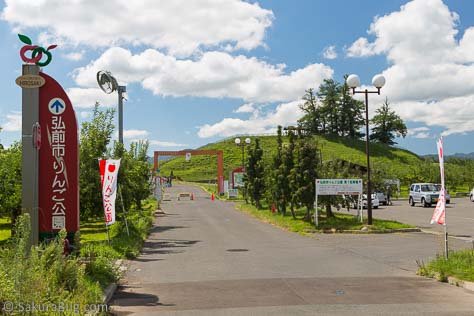
There are quite many apple farms within Aomori. If you are in the Hirosaki area, the Hirosaki Apple Park (弘前市りんご公園, Tel: 0172-36-7439) is a great place to visit and it’s quite convenient to get to. If you are in the Hirosaki city area, it’s a short 15min drive to the park. Entry to the park is free. If you are on a self drive trip, free parking is also available at the entrance to the park.
Entrance to Hirosaki Apple Park
The road leading to the park are small narrow streets, so you do need to keep a lookout for the signboard and turn into the small side street. I missed it the first time and had to drive through a second time.
Map of Hirosaki Apple Park
The Hirosaki Apple Park has a production area of around 2.49 hectares, housing 1,500 apple trees from 80 varieties. At the park, other than apple picking, you can also participate in the apple production experience. The apple production experience can start around May and the actual activities will depend on the production cycle at that time of the year. For apple picking, you will need to be there during the harvest season, which is around Aug to mid-Nov.
In addition, these are some of the festivals that are held at the park. Please do check before you travel as the festivals and timing do change from year to year.
Hirosaki apple harvest festival (Sep)
Hirosaki apple flower festival (May)
Hirosaki apple park winter festival (Jan)
Infoboard at Hirosaki Apple Park
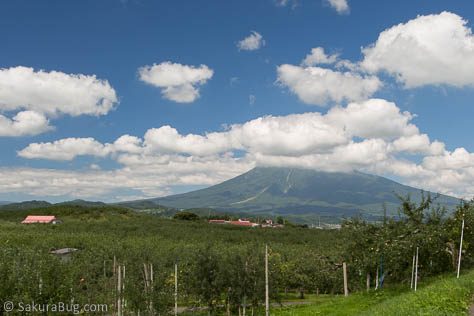
You can take a leisure stroll around the park to look at the different apple trees and enjoy the scenic view with Mt. Iwaki in the background.
View at Hirosaki Apple Park overlooking Mt. Iwaki
Alternatively, you could rent a bike from the Apple House near the entrance. Or explore the variety of 1,250 apple products within. If you are hungry, there’s a small café as well. Yes, apple ice cream is available at the Apple House!
For those travelling with kids. There are 2 fairly large playground/ picnic areas within the park. You can take a break there while the children have fun with the slides. Do bring along a mat and picnic basket with you for the trip!
Yes, I do love free and easy trips to Japan. I last spoke about Japan begin made up of four main islands, Honshu, Kyushu, Shikoku and Hokkaido. This time I was in the Tohoku region which is in Honshu. Today , I am going to cover my self drive trip in Akita, one of the 7 prefectures in Tohoku. The other 6 prefectures in Tohoku being Aomori, Iwate, Miyagi, Yamagata, Fukushima and Niigata.
When you are in Northern Tohoku, it is about as local and authentic as it can get. This isn’t a place where you will see many foreign tourists. During my trip there, all I could see were local tourists, I was the only foreigner in the area. I guess the reason might be that this is rather far from Tokyo for foreigners to want to make this side trip.
How did I land up in Akita? Well, I really wanted to go to Aomori but I wasn’t able to get a connecting domestic flight there. I reckoned that since I was driving, Akita wasn’t that far away from Aomori anyway. The thought of driving from Narita to Aomori did cross my mind. However, that’s a good 10 to 13 hours of driving, essentially driving the entire day. And the other killer bit would be the road toll that one would have to pay for the journey, which is probably more than the price of the domestic air ticket. And you would still need to add in the cost of fuel plus the day’s car rental cost.
I ended up spending 3.5 days in the Akita area and here are some of the place that I had visited.
1. AEON outlet near the airport
My flight landed in Akita is the late afternoon. At the airport, the Toyota Rent A Car shuttle van took me to the rental car station which was just beside the airport. This was a rather small place compared to the outlet at Chitose.
This time I rented the Toyota Ractis, a compact wagon. It was in a higher priced category P2 but ended up being cheaper than the P1 cars for me as the 15% Hertz Gold discount was applicable for the P2 category and above.
My first port of call was the Aeon outlet. This was a short, less than 10 minute, drive from the rental car station. At the supermarket, I picked up 2L mineral water bottles, green tea in pet bottles, snacks, buns, sweets and some instant noodle and instant porridge food packs. Much cheaper to shop here than to buy these at the convenience shops.
However, it was only on my drive back to the airport for my flight home that I realized that there was something like a shopping/restaurant strip in that area that I should have visited too, maybe on my next trip.
2. Akita city
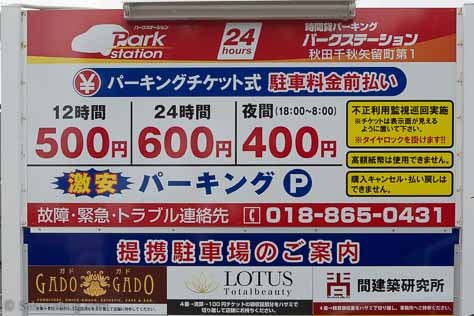
I spent the night in APA hotel, a business hotel located in the Akita city area. This hotel has some free parking lots, but as I had arrived rather late, all were taken up and I had to park at a public car park nearby. Fortunately, there was a favourable night parking rate.
Public car park signboard in Akita city
Then I walked towards the Akita station area to look for a place for dinner. If you are travelling in a group, this restaurant serving Akita food might be an interesting spot for you.
Restaurant in Akita City
Other than the few food establishments, it was rather quiet in the night.
3. Shirakami Sanchi
The next morning, I drove north towards Shirakami Sanchi. It was a nice relaxing drive along the coastal stretch in Noshiro after exiting the expressway.
Noshiro coastline, Akita
For details on my Shirakami Sanchi visit, please do see my earlier post featuring this UNESCO site.
4. Oga Peninsula coastline
Towards the end of the trip when I was back in Akita again, I stayed in North Akita instead of the city area for a change. I took this opportunity to explore the Oga Peninsula (男鹿半島) coast driving along route 59 which is hugging the coastline. To enjoy the scenic route drive, visit and experience the attractions along the way, it would probably take you an entire day or more.
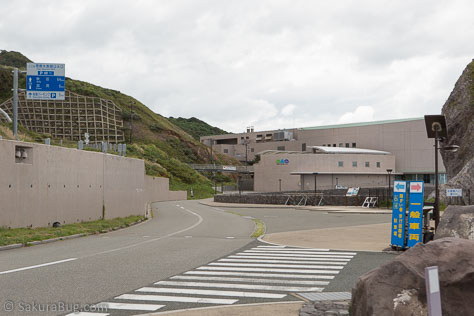
For more information, there is a small visitor centre /rest stop area which kind of marks your entry into the Oga area. You will not miss this place with these 2 Namahage giants marking the spot.
Namahage figures in Oga
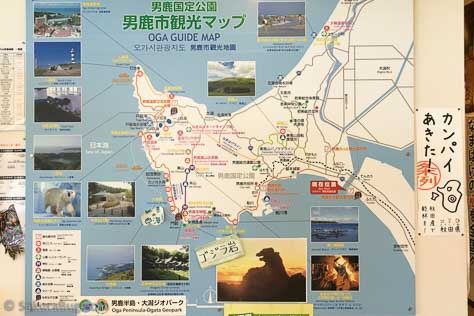
Inside the visitor centre, you will find this map of the Oga attractions on the wall.
Oga Guide Map from Visitor Centre
Here are some of the key attractions along the way.
a) Cape Nyudo Lighthouse
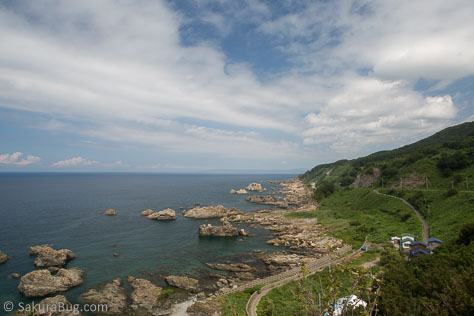
Cape Nyudo (入道崎) Lighthouse is one of the popular destinations. It is located at the extreme north end of the Oga Peninsula and offers a spectacular view of the rugged coastline and is an excellent spot for viewing the lovely sunset. This would likely be your final viewing stop along the Oga coast.
Cape Nyudo in Oga Peninsula
There is a pathway down to the shoreline if would like a closer view of the rocks.
Coastline at Cape Nyudo, Oga
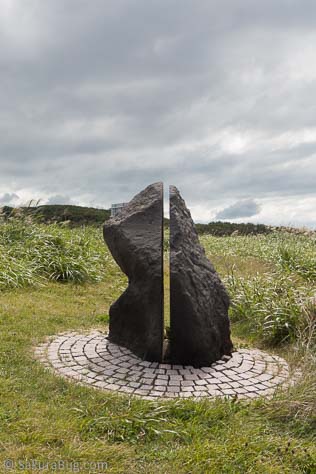
Found in the same area are stone markers indicating the 40 degree north latitude line.
Rock at Cape Nyodu showing 40 deg latitude north
b) Oga aquarium GAO
The Oga aquarium GAO (男鹿水族館GAO, Tel: +81-185-32-2221) is located at the southern end of the Toga bay facing the Sea of Japan. This would probably be your stop just before Cape Nyudo Lighthouse. It features the following exhibits:
Umidai aquarium of Oga
Saltwater fish corner of Japan
Akita river Corner
Coral Corner
Amazon Corner
Polar Bear
Penguin
Jellyfish Corner
Sandfish (sandfish Museum)
Touch pool
Flipper ‘s Museum
Oga Aquarium GAO
And if you hungry, there is a restaurant serving lunch.
c) Namahage museum
The Namahage museum (Tel: 0185-22-5050, なまはげ館) is located in the Shinzan area within Oga. This is one of the attractions that is not along the coastline, so you would to make a detour. The museum serves to provide information about the Namahage history and traditions. You might also be able to catch a performance or enjoy the experience of transforming yourself into a Namahage.
Namahage Museum (Picture from Namahage Museum site)
d) Godzilla rock
Godzilla Rock (ゴジラ岩) is one of the geological attractions here, a natural sculpture caused by erosion from waves. It is aptly named due to its close resemblance to the Godzilla character. To catch the perfect view of fire (evening sun) coming out from Godzilla’s mouth, you might want to visit during mid-April or mid-October.
Unfortunately I did not have enough time to explore more places and in more detail. It was a hurried visit as it was unplanned. In addition, there was a hurricane warning that day for the evening and I wanted to be back in the hotel before then. Hopefully I will be able to make another trip soon. In the meantime, have a fun time exploring Akita and the Oga coastline!