Tag Archives: self drive

7 places to visit around Fukuoka, Kyushu

Japan is made up of four main islands, Honshu, Kyushu (九州) and Shikoku and Hokkaido. Today, we will be going on a free and easy trip around Fukuoka (福岡) located in Kyushu. The city of Fukuoka is also known as Hakata.

For this self drive trip, I took roughly a circular route starting from Fukuoka, then headed south to Kumamoto. Next on the destination was the Aso area before taking the Yamanami scenic route to Oita/Beppu. On the way back to Fukuoka, I also made a detour to the Tosu factory outlet (Premium outlets) for some shopping.

Fukuoka became the staging point for me in this free and easy journey. Our very first stop was the Aeon Mall in Fukuoka to stock up on supplies plus dinner in the shopping complex. Then it was time to get some rest at the hotel before taking the drive south to Kumamoto the next morning.
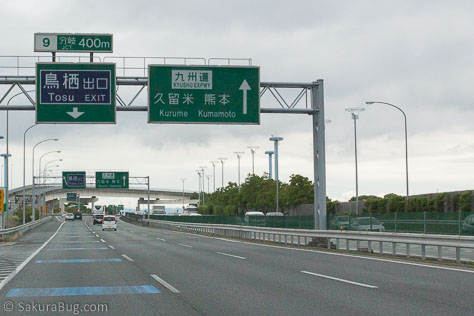
Picture of Kyushu Expressway to Kumamoto
Kyushu Expressway to Kumamoto

1. Kumamoto city and Kumamoto Castle

Kumamoto is located roughly in the centre of Kyushu. It is a major city with a population of around 750,000. It is also called a “City of Forests” since green forests cover about 60% of the entire prefecture.

It also houses one of the largest-scale shopping arcade in Japan. The arcade is in the city centre, housing a huge variety of shops. We stayed in the city area and was able to walk around town and explore the shopping arcade.
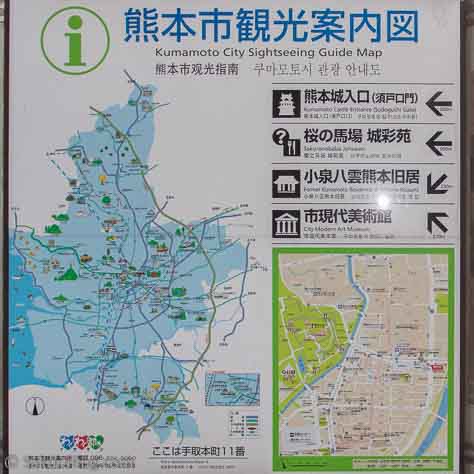
Picture of Kumamoto City Map
Kumamoto City Map

Kumamoto Castle (熊本城), one of the great castles in Japan, is a big tourist magnet located in centre of the city area. Unfortunately, there was heavy damage to the castle in the April 2016 earthquake and it is now closed to the public.


2. Fruit picking in Kumamoto fruit farms

Kumamoto is also known as the land of fruits. There are various farms which you could visit for fruit picking. Kichijien (吉次園, Tel: 096-273-2544) is one of the tourist farms which you can visit. It is located in the more remote farm areas quite a distance away from the city. You will need a rental car to get there.

Do take note of the fruit picking season. While they are open most of the year, June is when it is closed to visitors.
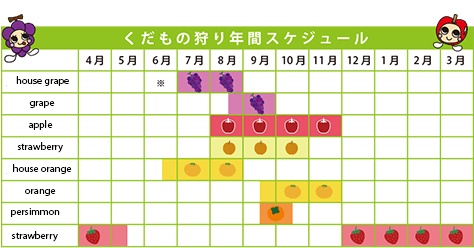
Kichijien fruit picking schedule from their website with added English overlay


3. Aso Farm Land

Next on the route was Aso Farm Land (阿蘇ファームランド, Tel: 0967-67-2100). This is a rather interesting and unique place, which combines Experience, Sports, Healing, Gourmet, Stay and Shopping in one huge expansive location. There is some impact from the April 2016 earthquake and the resort will be reopened in August 2016.

One of the things that catches your eye would be the unique accommodation facilities. There are a few  clusters of dome huts very much like igloos against the Aso mountain range backdrop. These are the hotel rooms that you will be staying in. This would be the “Stay” zone.
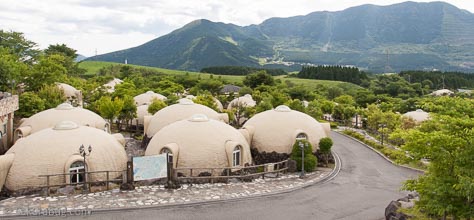
Picture of dome huts in Aso Farm Land
Dome huts in Aso Farm Land

Hot springs can be found in the “Healing” zone. There are different options available, such as the open air spa, hot spring with scenic view, the mineral water bath and the herbal water bath.

There are different sporting activities available in the “Sports” zone which is in the Forest Vitality area. There are different interactive equipment here to get a fun workout in a nature setting.

In the “Experience” zone, you will be able to get close up to some farm animals. There is also a feeding area where some animals are roaming around. You can buy animal feed from a dispenser and have fun feeding these animals in the enclosure.
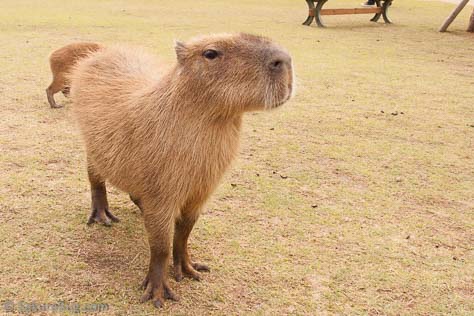
Picture of animal enclosure in Aso Farm Land
Animal enclosure in Aso Farm Land


4. Mount Aso

Near to Aso Farm Land is Mt. Aso. (阿蘇山), located within the Aso-Kuju National Park. It is an active volcano with a massive caldera housing a range of five peaks including Mt. Nakadake and its crater.

Due the increased volcanic activity, probably due to the April 2016 earthquake, access to the Nakadake crater has been closed. There is a level 2 eruption warning and all area within 1km of the carter is off limits. Previously, you could either take the Mt. Aso ropeway (Tel: 0967-34-0411) to the visit the crater or even drive up via a toll road.
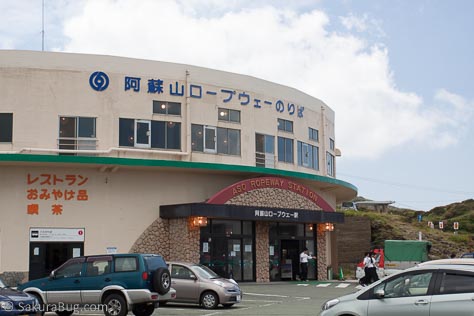
Picture of Mt. Aso Ropeway Station
Mt. Aso Ropeway Station
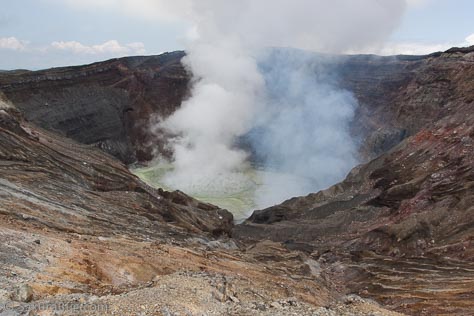
Mt. Nakadake's crater
Mt. Nakadake’s crater


5. Yamanami scenic route and Kokonoe Yume Suspension Bridge

The Yamanami Highway or Route 11 in the maps takes you through the rolling, grass covered hills of Kyushu. It roughly stretches from Beppu City/Oita to Aso City/Kumamoto. It is a popular drive with many great hot spring spots along the way. There are also many scenic viewing spots as well as trails for hiking and walking.

One of the key attractions along the route is the Kokonoe Yume Suspension Bridge (九重”夢”大吊橋, Tel: 0973-73-3800). Standing at 173m tall and spanning 390m long, it is the highest pedestrian walkway bridge in Japan. From the bridge, you would be able to see Shindonotaki falls (震動の滝), which is among the top 100 waterfalls in Japan.
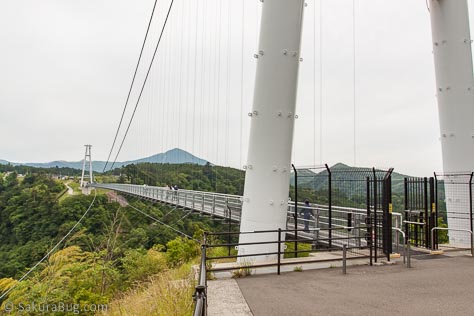
Picture of Kokonoe Yume Suspension Bridge
Kokonoe Yume Suspension Bridge


6. Chojabaru Visitor Centre

Another place to visit along the Yamanami Highway would be the Chojabaru Visitor Centre (Tel: 0973-79-2154) which is within the Aso Kuju National Park, midway between Aso and Yufuin. From the Visitor Centre, you will be able to catch of view of the Mt Io and the three domed Mt. Mimata.
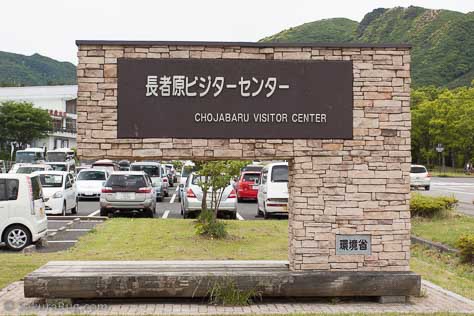
Chojabaru Visitor Centre

The key feature would be the Tadawara Marsh on the north west side of the Kuju mountain range. It is a basin shaped wetland caused by historical volcanic activity. There are 3 walking courses to choose from, the Marsh Boardwalk, the Marsh and Grassland trail and the Forest trail. The shortest course would be the Marsh Boardwalk, taking about 20 to 30 minutes at a very leisurely pace. The entrance to the boardwalk is near to the Visitor Centre.


7. Mt. Takasaki Wild Monkey Park

As we continue driving east, we reached Oita (大分), which is where the Mt. Takasaki Wild Monkey Park (高崎山自然動物園, Tel: 097-532-5010) is located. It is a monkey reserve at the base of Mount Takasaki, housing around 1400 wild monkeys that roam freely on the mountain slopes. Yes, these are wild monkey and visitors must keep their distance, neither tease nor feed them and not to look them in the eye.

The park was opened as a way to solve the human-monkey conflict. These monkeys are feed regularly so that not encroach into residential areas nor farming areas. You can see the huge hordes of monkeys running for the food when it’s feeding time.
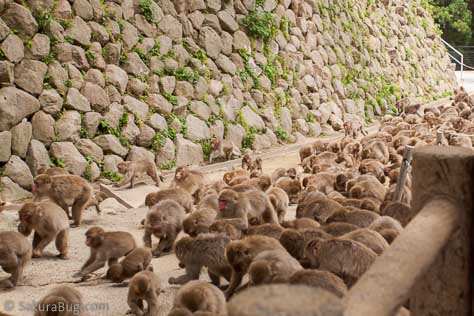
Picture of monkeys feeding at Mt. Takasaki
Monkeys feeding at Mt. Takasaki


With that, we headed back to Fukuoka, but made a detour to Tosu, location of the nearest Premium Outlets.


Ja
KL
3 reasons to visit Hokkaido

Thinking of a free and easy trip to Japan? Try a self drive trip in Hokkaido (北海道). Here are 3 reasons why Hokkaido is a great destination.

1. Easy for self drive

Of the four main islands that form Japan, Hokkaido is the second largest. However, it is the least developed. It accounts for around 20% of Japan’s land mass but only around 5% of the population. This low population density creates a generally relaxed environment far from the madding crowd.

Hokkaido houses an international airport in Chitose. There are a few international airlines that fly direct into the New Chitose Airport. If not, there are many regular, almost hourly flights connecting from Narita, Haneda or Osaka. It is very convenient to fly into Hokkaido. If you want to be closer to your destination, there are other domestic airports within Hokkaido for more direct access.

The rental car stations are located either beside or offsite but near to the airport. In which case, there usually would be shuttle buses operated by the rental car company to bring you to the offsite location.

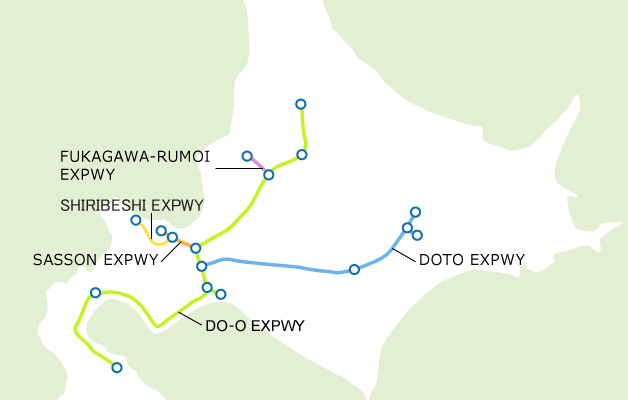
From a road network perspective, the expressways do cover a large part of Hokkaido. The expressway operator for Hokkaido is the East Nippon Expressway Company Limited, or sometimes abbreviated to East NEXCO. You can find more info on the expressway network here.

Hokkaido expressways (Picture from East NEXCO Driveplaza)

As you can see from the map provided by East NEXCO above, the expressways do cover a big part of Hokkaido especially on the central and southern areas. You will be able to use the expressways most of the time if you are in both these areas.

So self drive is a breeze in Hokkaido.

  • Hokkaido is easily accessible as a destination
  • Road traffic is generally low as the population density is low.
  • Good expressway network covering a good part of Hokkaido
  • Rental cars are easily available.


2. Great place for flowers and autumn colours

My fascination in Hokkaido started with wanting to partake in the Sakura season. Other than Sakura or Cherry Blossom, there are many other beautiful flowers and magnificent sights to catch at different times of the year.

4 seasons in Hokkaido

The climate in Japan could vary significantly as you look across the southern to the northern end of Japan. Hokkaido is located on the northern-most end of the four main islands of Japan. It tends to have a shorter summer and longer winter. This also impacts the timing of when the different flowers bloom in Hokkaido.

Some of the other flowers that you could view are the Wisteria, Tulip, Lavender, Moss Pink, Sunflower and Lilac. Here is a table of some of the approximate timing when they are in bloom.

Table of Hokkaido flower season
Hokkaido flower season

For recommended places to view the Cherry Blossoms, please see my previous articles on Sakura viewing in Central Hokkaido and Southern Hokkaido. For the other flowers, if I hear enough feedback, I will write a full article on them. Reason for another Hokkaido adventure :).

In the meantime, here are some possible places to go to amongst others.

Flower viewing in Hokkaido

Of course, the main flower belt is in Central Hokkaido, in the Biei/Furano area. So if you do not want to travel too much, then you might want to stick around Biei/Furano. However, you will need to travel around Hokkaido if you want to view a greater variety of flowers.


3. Choice of 6 national parks including UNESCO site Shiretoko


With 20% of the total land mass and 5% of the population, you get to enjoy a lot of pristine mostly unspoiled nature areas. There are 6 National Parks in Hokkaido for you to choose from:

  1. Daisetsuzan National Park
  2. Shikotsu-Toya National Park
  3. Akan National Park
  4. Shiretoko National Park (UNESCO site)
  5. Kushiro-shitsugen National Park
  6. Rishiri-Rebun-Sarobetsu National Park

Daisetsuzan is the largest national park in Hokkaido and in Japan. It covers an area of around 226,000 ha in Central Hokkaido. Mt. Asahidake, which is Hokkaido’s highest peak, is part of the national park and stands at 2,291 m above sea level. In this huge expanse of land with different climatic conditions due to the varying elevations, you can find a rich diversity of wildlife such as brown bears, sika deer, red fox, Japanese Pika and Hokkaido squirrels. If you are into bird watching, you might be able to catch a glimpse of the Blakiston’s fish owls or the rare Eurasian three-toed woodpecker on a lucky day.

Shikotsu-Toya National Park, which is almost half the size of Daisetsuzan (around 96,000 ha), is also in the Central Hokkaido region located near to Sapporo. This is an area known for its volcanic activity and hot springs. Noboribetsu is one of the well known areas for its hot springs here.

For Akan National Park and Kushiro-shitsugen National Park, please check out my earlier post on interesting places to visit while in Kushiro. For Shiretoko National Park, which is a UNESCO site, do read my earlier post on a self drive trip to Shiretoko.

Rishiri-Rebun-Sarobetsu National Park is the smallest of the 6 national parks here, at around 24,000 ha, located in Northern Hokkaido. The key attractions here are Mt. Rishiri, Rebun-to Island, the Coastal Sand-dune Area and the Sarobetsu Plain. Unfortunately, I have yet to make a trip to the northern extreme of Hokkaido, something that I would like to do in the future.

What you waiting for? You have your 3 reasons, time to make that Hokkaido self drive trip!

Ja
KL


4 interesting places to visit in Kushiro driving from Shiretoko

Last month I wrote about the road trip to the Shiretoko National Park (知床国立公園), and I spoke about making a stop at Kushiro (釧路) to break up the long self drive journey. You could drive all the way south after stopping by Shiretoko pass to reach Kushiro. After spending a day here, you could continue west towards Chitose.

Kushiro is situated in the south eastern part of Hokkaido, facing the Pacific Ocean. This coastal city has flourished as a port city and today is one of the big cargo ports in Japan. The city itself  is enclosed by the Pacific Ocean in the south and the Kushiro Marsh in the north. However, the Kushiro sub-prefecture stretches all the way to Lake Akan to the north. Most of the interesting places are located away from the central city area so a self drive trip is necessary if you want to explore these places at your own pace.

Here are 4 interesting place to visit while you are in Kushiro.

1. Kushiro Fishermen’s Wharf

If you are spending the night in Kushiro, you will probably find lodging in the central city area, which is where the Kushiro train station is also located. Near the central city area, you will also find Kushiro Fishermen’s Wharf MOO, a very popular place for both the local people and visitors.

Picture of Kushiro Fisherman's Wharf MOO logo
Kushiro Fisherman’s Wharf MOO

You could do some general shopping or souvenir shopping if you need to bring some gifts home. Otherwise, you could just relax and stroll along the Kushiro riverside or take a boat cruise along the river.

Picture inside Kushiro Fisherman's Wharf MOO
Shopping inside Kushiro Fisherman’s Wharf MOO

If you are feeling hungry, there are some places for a meal within the complex itself or you could explore the surrounding restaurants.

Picture of restaurant near Kushiro Fisherman's Wharf MOO
Restaurant near Kushiro Fisherman’s Wharf MOO


2. Kushiro-shitsugen National Park

To the north of Kushiro city, you have Kushiro-Shitsugen National Park (釧路湿原国立公), Japan’s largest marshland. It was designated a national park in 1987 and is home to the endangered Japanese Cranes. Some activities to do here include bird watching, nature viewing and trail walking.

You could start your trip by heading to the Kushiro Marsh Observatory (釧路市湿原展望台, Tel: 0154-56-2424). There is a big car park just beside the Observatory. Parking is free but there are admission fees to enter the Observatory. Once inside, you can get an excellent view of the Kushiro-Shitsugen Wetland from the third floor observation area. The scale model of the wetland area within should give you a good overview of the surrounds. Furthermore, there are also various displays and information regarding the flowers, plants and wild life that you can find in the marshland.

Picture of Kushiro Marsh Observatory
Kushiro Marsh Observatory

No biggie if you want to give the Observatory a miss and proceed straight to the boardwalk trails to see the real stuff. You should be able to complete the 2.5km loop in around an hour, much like a nature walk giving you a good view of the marshland.

Picture of Kushiro marshland boardwalk trail (Picture from Kushiro Tourism Association)
Kushiro marshland boardwalk trail (Picture from Kushiro Tourism Association)

Other places to observe the marshland include:

  • Hosooka Viewpoint (Hosooka Visitor’s Lounge, Tel: 0154-40-4455)
  • Hokuto Viewpoint
  • Kottaro Marsh Viewpoints
  • Onnenai Boardwalk (Onnenai Visitor Center, Tel: 0154-65-2323)
  • Sarubo Viewpoint


3. Kushiro Tancho Nature Park (Japanese Crane Reserve)

To the south west of Kushiro Marsh Observatory, you will find the Kushiro Tancho Nature Park (釧路市丹頂鶴自然公園, Tel: 0154-56-2219) or sometimes referred to as the Japanese Crane Reserve. The reserve was opened in 1958 and since 2000 has been under the management of the Kushiro Zoo where there is a more concerted effort to promote the protection of the Japanese crane. Do note that admission tickets are required to enter the reserve.

While this is a great place to get up close to observe the birds, it is a relatively small facility. So some might not find it worthwhile in a standalone trip. It would be good to combine this with the Observatory trip.

Picture of Japanese Crane Reserve
Japanese Crane Reserve (Picture from Japanese Crane Reserve)


In addition to the Japanese Crane Reserve, you will also be able to find cranes at the Akan International Crane Centre (Tel: 0154-66-4011) and Tsurui Ito Tancho Crane Sanctuary (Tel: 0154-66-4011, closed on Tuesdays and Wednesdays). The Akan International Crane Center is a research facility and the adjoining Akan Crane Observation Center is a feed site. As the Hokkaido winter is very harsh, the cranes are unable to find enough food. Feed sites such as this help them survive. During the winter months, feeding time is scheduled for 2:00pm every day at the Center.

Can cranes dance? If you are visiting between February and March, you will be able to observe the dazzling displays of courtship as this is the breeding season for the cranes, turning the fields into their dance floor. Later in the May to June period, you might just get to see some crane chicks.


4. Lake Akan

All the way towards the north end of Kushiro sub-prefecture, you have Lake Akan (阿寒湖, mapcode 739 401 785*14) located in the Akan National Park. Rather than lumping this with the rest of the Kushiro stops on the way back from Shiretoko, I would suggest that you stop by Lake Akan on your way towards Shiretoko instead. The lake is along Route 241, which brings you heading NE towards Shiretoko.

Lake Akan is one of the 3 caldera lakes found in the Akan National Park, the other two being Lake Kussharo (屈斜路湖) and Laku Mashu (摩周湖). A caldera is a volcanic crater that could be formed by either an explosive volcanic eruption (explosive caldera) or the collapse of the magma chamber (collapse caldera).

Here you will find Marimo (毬藻), which is a rare algae species that grows into beautiful green balls, a feature unique to Lake Akan. There are only a few places in the world where you can find Marimo, even fewer when you are looking for large colonies of Marimo. They thrive under the unique conditions found here in Lake Akan. When you leave Lake Akan, you will carry with you the memory of this Marimo encounter more than anything else.

Picture of Marimo
Marimo (Picture from Lake Akan Tourist Information Center)

You could visit the Lake Akan Tourist Information Center (Tel: 0154-67-3200) to get brouchures, maps and other sight seeing information. They are also offering a bike rental service.

So have fun as you rest along your way towards (or back from) Shiretoko!

Ja
KL